Western Australia is, by almost any measure, one of the most logistically challenging places on earth to move temperature-sensitive goods. The state covers 2.6 million square kilometres. Its regional centres are separated by vast distances of outback with no refrigerated infrastructure between them. Summer temperatures in the Pilbara and Kimberley regularly exceed 45°C. And Perth, where the majority of the population and commercial activity is concentrated, sits more than 2,700 kilometres from the nearest major interstate hub.
For any business that needs to move perishable food, pharmaceutical products, biological samples, or other temperature-sensitive goods within or out of WA, the cold chain is not an abstract logistics concept. It is a daily operational challenge with real consequences when it breaks down.
Dry ice has become an increasingly important part of how WA businesses meet that challenge, and for reasons that go well beyond simply keeping things cold.
What the Cold Chain Actually Means
The cold chain refers to the unbroken sequence of temperature-controlled handling, storage, and transport that keeps a product within its required temperature range from the point of production to the point of delivery. A break anywhere in that chain, a delay, an undersized cooler, or a product left on a loading dock in the afternoon heat, can compromise the entire shipment.
In a state the size of WA, maintaining that chain across long distances, variable transport modes, and extreme ambient temperatures requires more than a refrigerated truck. It requires a cooling medium that is reliable, practical to use in remote or non-refrigerated environments, and capable of maintaining consistent temperatures for extended periods without requiring power or active refrigeration equipment.
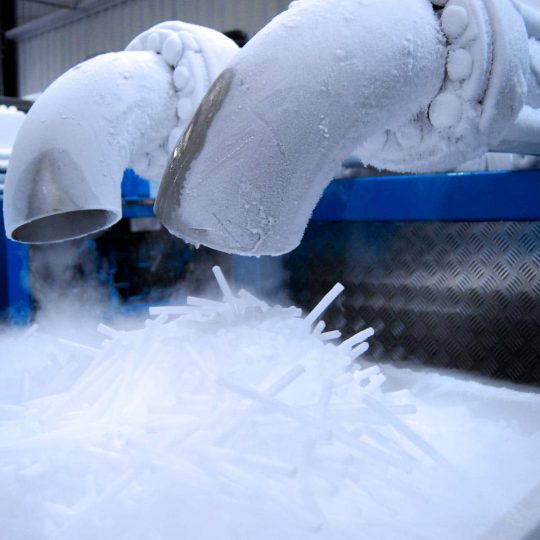
That is where dry ice earns its place. At -78.5°C, it maintains far lower temperatures than conventional ice or gel packs, and it does so without producing any moisture. It sublimates directly from solid to gas, leaving the shipment dry and unaffected by liquid melt. For goods that cannot tolerate any moisture or that require ultra-low temperature maintenance, it is in a category of its own.
Food and Perishable Goods: Keeping WA’s Supply Chain Intact
The food and beverage sector is one of the highest-volume users of dry ice in cold chain logistics. WA’s fishing industry, agricultural exporters, and food distributors all face the same core problem: how do you keep fresh seafood, meat, and produce at safe temperatures across long transport runs when refrigerated vehicles are expensive, not always available, and not always practical for every leg of the journey?
Dry ice in transport and logistics provides a flexible, cost-effective answer. It can be used in standard insulated eskies and foam boxes without any powered refrigeration equipment, which means it works in ambient-temperature courier vehicles, in charter aircraft, in the back of a ute heading to a remote station, or on a vessel headed out to a mine site. The goods stay cold without the infrastructure cost of a full refrigerated supply chain.
The advantage over traditional wet ice or gel packs is significant for product quality. Wet ice produces melt water that can affect texture, accelerate spoilage, and compromise packaging. Gel packs have limited cooling capacity and do not maintain the ultra-low temperatures required for products like raw seafood, premium meat cuts, or certain dairy goods. Dry ice produces none of that. The product arrives dry, cold, and in the same condition it left.
For WA’s seafood exporters moving product to interstate and international markets, that quality difference matters commercially. A king prawn or Fremantle octopus that arrives at a Sydney or Singapore restaurant in perfect condition commands a premium that a product damaged by melt or temperature abuse simply cannot.
Pharmaceutical and Medical: Where Cold Chain Failure Has Real Stakes
The consequences of cold chain failure in the food sector are usually financial. In the pharmaceutical and medical sector, they can be clinical.
Vaccines, particularly mRNA-based formulations, require storage and transport at ultra-low temperatures, often between -70°C and -80°C. Standard freezers and most refrigerated transport systems cannot reach or reliably maintain those temperatures. Dry ice can, and does so passively, without power, without calibration, and without the failure modes associated with mechanical refrigeration.
Medical and pharmaceutical cold chain applications in WA span a wide range of materials: vaccines, biologics, protein-based medications, blood samples, plasma, human tissue, organs for transplantation, and clinical trial samples. For hospitals, pathology labs, biotech firms, specialty pharmacies, and research institutions operating across the Perth metro area and into regional WA, dry ice is often the only practical way to maintain cold chain integrity across the distances involved.
Regional WA presents specific challenges here. A clinical sample collected in Broome, Kalgoorlie, or Port Hedland that needs to reach a Perth laboratory in viable condition cannot rely on refrigerated couriers for every leg of the journey. Dry ice packed into a well-insulated container, correctly labelled for transport, gives that sample the best chance of arriving intact regardless of the logistics pathway it travels.
The same logic applies to outbound pharmaceutical supply. Specialty medications that require strict temperature control, whether being delivered to patients in metro Perth or dispatched to remote health services, must remain within their required temperature range door to door. Dry ice in appropriately sized insulated packaging achieves that without the complexity and cost of refrigerated freight on every leg.
The Cost Case for Dry Ice Over Refrigerated Transport
Refrigerated vehicles and containers are expensive to hire, operate, and coordinate. For large, regular shipments between fixed points, they make sense. For smaller, irregular, or multi-drop shipments, especially across WA’s distances, the economics often do not stack up.
Dry ice offers a practical middle path. A correctly sized insulated container packed with the right quantity of dry ice can maintain product temperatures for twelve, twenty-four, or more hours without any powered refrigeration. It can travel on a regular courier, in a charter flight, in a private vehicle, or on public transport. It does not need to be plugged in, pre-cooled, or returned to a depot. It simply works until the dry ice sublimates, which in a well-insulated Low Loss Container happens far more slowly than most people expect.
For businesses that need cold chain capability without the overhead of a full refrigerated fleet, that flexibility is valuable. Dry ice turns any standard insulated container into a temperature-controlled shipping solution.
Dry Ice and WA’s Regional and Remote Logistics Challenge
Perth is remote from the rest of Australia. But many of WA’s most important industries operate even further from the state’s logistics centres. Mining operations in the Pilbara, pastoral stations across the Midwest and Kimberley, fishing operations out of Exmouth and Esperance: all of these require goods to move in and out across enormous distances with limited cold chain infrastructure along the way.
Dry ice makes temperature-sensitive logistics possible in these environments in a way that active refrigeration cannot easily replicate. It can be supplied in bulk from Perth, packed into insulated containers, and sent via road freight, air freight, or company vehicles to remote sites. Once there, it keeps food, pharmaceutical supplies, and biological samples cold without requiring power connections or refrigeration equipment that may not exist on site.
For transport and logistics operators working with clients across regional WA, dry ice is often the difference between a cold chain that works and one that simply cannot be run at all given the available infrastructure.
Choosing the Right Setup: Pellets, Containers, and Quantities
Getting cold chain logistics right with dry ice comes down to three variables: pellet size, container quality, and quantity relative to the required hold time.
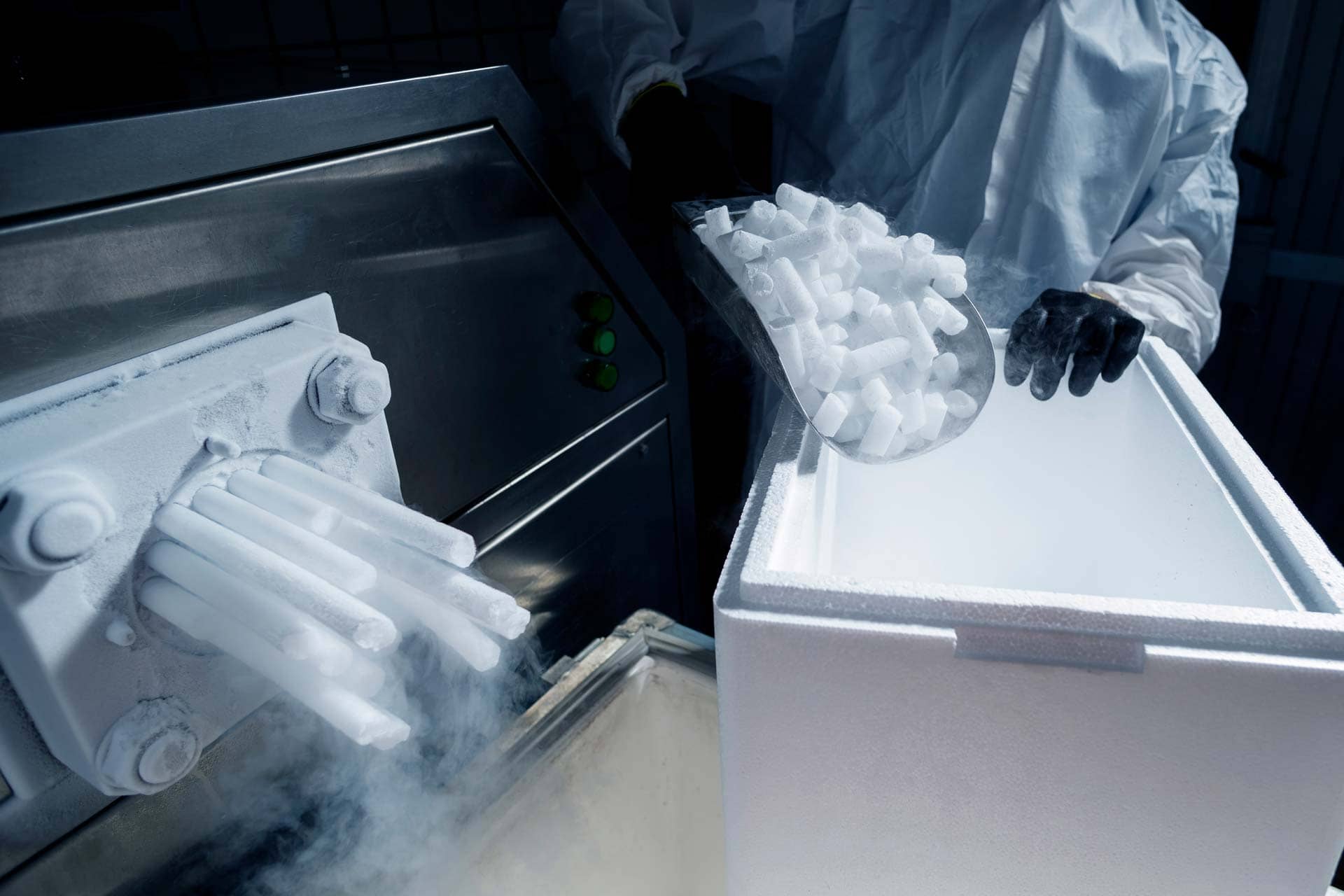
For most transport and logistics applications, 10mm pellets are the preferred choice. Their larger size means a lower surface-area-to-volume ratio and slower sublimation, which translates to longer effective cooling time per kilogram. For a shipment that needs to hold temperature for twelve hours or more, that slower rate is a meaningful advantage.
Container quality has perhaps the largest single effect on how long the dry ice lasts. A standard foam esky will work for same-day or short-run transport. For larger quantities or longer hold times, Low Loss Containers are the professional standard. These specialist insulated containers are specifically engineered to reduce sublimation and maintain the dry ice in optimum condition throughout the journey. They are available in sizes holding up to 200kg, 250kg, and 350kg, making them practical for bulk pharmaceutical, food, or industrial cold chain shipments.
The right quantity depends on the hold time required, the container used, and the ambient temperatures the shipment will travel through. WA’s summer conditions can significantly accelerate sublimation in undersized or poorly insulated containers. Getting the quantity right means factoring in not just the scheduled transport time but any delays, layovers, or loading dock wait times that might extend the journey beyond the plan.
Timing and Supply
Because dry ice sublimates continuously from the moment it is produced, timing the supply around the shipment is important. Collecting or receiving dry ice too far in advance means a meaningful portion of the product has already sublimated before the goods even leave the warehouse.
Orders placed before 11:30 AM are available for next-day collection or delivery across the Perth metro area. For bulk orders and regional deliveries, supply is coordinated through trusted logistics partners to ensure the dry ice arrives as fresh as possible relative to when it is needed. For regular cold chain operators, establishing a consistent supply schedule tied to shipment days is the most practical way to ensure the product is always available at the right time and in the right quantity.
The pick-up and delivery options available from Myaree cover the Perth metro area Monday to Friday, with regional WA deliveries coordinated through freight partners. For businesses running regular cold chain operations, a reliable, local dry ice supply that understands the logistics of the WA market is not a minor detail. It is the foundation the whole operation runs on.
WA’s geography is not going to change. The distances are real, the heat is real, and the cold chain challenges that come with them are not going away. What dry ice offers is a proven, practical, and cost-effective way to manage those challenges, one shipment at a time.