
One of the most common questions people ask before buying dry ice is how long it will actually last. The honest answer is that it depends on several things working together: the pellet size, the container you use, where you store it, and how often you open the lid. Get those factors right and your dry ice will go much further than you might expect. Get them wrong and you will lose product faster than you planned for.
Here is a practical breakdown of what affects dry ice longevity, how the two pellet sizes compare, and what you can do to slow sublimation and get the most out of every kilogram.
Why Dry Ice Disappears Without a Trace
Dry ice sublimates rather than melts. At -78.5°C, it converts directly from a solid into carbon dioxide gas, skipping the liquid stage entirely. That is what makes it so useful, no mess, no water, no residue. But it also means the clock starts ticking from the moment it is produced.
Unlike regular ice, you cannot refreeze dry ice or slow its sublimation by putting it in the freezer. In fact, placing dry ice in a household freezer is counterproductive: the extreme cold causes the thermostat to shut off, potentially allowing other frozen items to begin thawing. The better approach, which most people find counterintuitive, is to store dry ice at room temperature in a well-insulated container with a vented lid.
Pellet Size Matters More Than Most People Realise
The two pellet sizes available, 3mm pellets and 10mm pellets, behave differently when it comes to storage life, and understanding why helps you choose the right product for your needs.
3mm Pellets
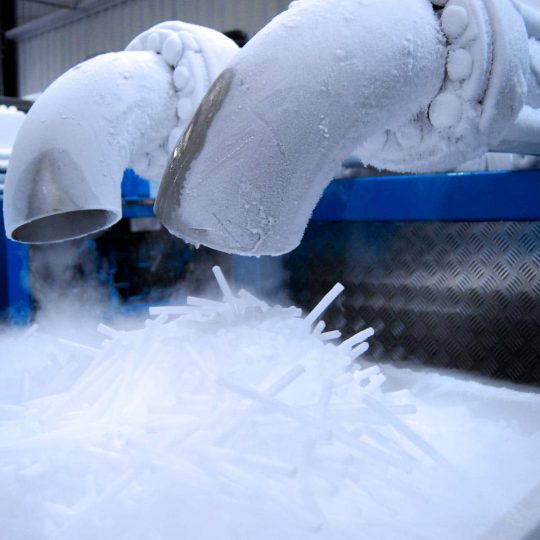
The 3mm pellet is a thin, straw-like cylinder approximately 3mm in diameter. Despite its small size, it is manufactured to a high density, which is precisely what gives it a longer shelf life relative to its surface area. High density means less air space within the pellet itself, so sublimation happens more slowly from the inside out.
That said, 3mm pellets do have a higher surface-area-to-volume ratio than larger pellets, which means more of the pellet is exposed to ambient temperature at any given moment. In a standard foam esky at room temperature, you can expect to lose roughly 5% to 10% of your dry ice per hour depending on insulation quality and how often the container is opened. In a well-sealed, high-quality insulated container, that rate slows considerably.
3mm pellets are the go-to choice for dry ice blasting and food production applications, where the pellet needs to be used relatively soon after collection. For these applications, the high density and consistent sizing matter more than extended shelf life.
10mm Pellets
The 10mm nugget-style pellet is noticeably larger and has a lower surface-area-to-volume ratio. More of the dry ice mass is contained within the interior of each pellet, insulated by the pellet itself, which means it takes longer to sublimate. In practical terms, 10mm pellets will outlast 3mm pellets under the same storage conditions.
This makes the 10mm pellet the preferred choice for applications where dry ice needs to remain effective over a longer period: food and beverage transport, pharmaceutical cold chain logistics, industrial cooling, and special effects at events where the dry ice needs to hold through a long setup period before being used. When you are cooling a shipment overnight or keeping product temperature stable across a multi-hour event, the 10mm pellet gives you more working time per kilogram.
How Your Container Changes Everything
Pellet size is only one part of the equation. The container you store dry ice in has an equally significant effect on how long it lasts.
A standard foam esky provides a decent level of insulation for small quantities and is practical for transporting up to 25kg. Sublimation rates in a foam esky are higher than in specialist containers, so this option suits short-term use: same-day events, quick transport runs, or applications where the dry ice will be consumed within a few hours of collection.
A well-insulated polystyrene box performs better than a basic foam esky and is a practical step up for slightly longer holds. Keeping the lid closed as much as possible and storing the box in a cool, shaded, ventilated area makes a meaningful difference.
Low Loss Containers are the gold standard for anyone needing dry ice to stay in peak condition for an extended period. These are specialist containers with a high level of thermal insulation, specifically engineered to reduce sublimation. They are available in sizes holding up to 200kg, 250kg, and 350kg. Bulk orders over 100kg are delivered in Low Loss Containers as standard, and for large industrial, medical, or multi-day event applications they are the only sensible choice. The full storage and transport guidance gives a detailed overview of when each container type is appropriate.
General Storage Life Estimates by Scenario
While exact sublimation rates vary with temperature, humidity, and how well sealed your container is, here are realistic working estimates:
Small quantity (5 to 10kg) in a foam esky: Plan to use within 4 to 8 hours. You will have product remaining after that, but the rate of loss accelerates as the insulating mass of the dry ice itself reduces.
Medium quantity (20 to 50kg) in a polystyrene esky or foam box: Usable for 12 to 24 hours with good insulation. Opening the container frequently will shorten this considerably.
Large quantity (100kg+) in a Low Loss Container: Dry ice can remain effective for 24 to 48 hours or more, depending on container quality, ambient conditions, and how often it is accessed.
The key takeaway: the more dry ice you have and the better your container, the slower the proportional sublimation rate. A full, well-sealed Low Loss Container loses product far more slowly per kilogram than a half-empty foam esky.
The Single Biggest Mistake People Make
Buying dry ice too early. Because sublimation is continuous and unavoidable, collecting dry ice days or even the night before you need it means you are working with a fraction of what you ordered by the time it matters. Same-day or next-day collection is always the right approach.
Bulk orders placed before 11:30 AM are ready for collection or delivery the following day. For events, food preparation, or any application with a specific timing window, building your order around that schedule means you receive the freshest, densest product and lose as little as possible before use.
Practical Tips to Make Your Dry Ice Last Longer
Keeping a lid on things, literally and figuratively, goes a long way. A few habits make a real difference:
Keep the container closed unless you are actively using the dry ice. Every time the lid comes off, warm air replaces the cold layer that has built up inside and sublimation accelerates.
Store in a cool, shaded, ventilated area. Direct sunlight or a hot car boot dramatically increases sublimation rates. A shaded garage or a cool room out of direct heat is ideal.
Do not wrap dry ice in a sealed plastic bag or airtight container. The CO2 gas has to go somewhere, and if it cannot escape, pressure builds to the point where the container can rupture. The lid on your esky or storage box should sit firmly but not be hermetically sealed.
Use the right container for the quantity. If you only need 5kg, a purpose-sized foam box holds it more efficiently than a large esky with a lot of air space. The ratio of insulation to dry ice matters.
If you are storing dry ice between uses at an event, keep it in the container with the lid on rather than setting it out in the open. Even a short period of open-air exposure adds up across a long event day.
Which Pellet Is Right for You?
If you need dry ice for blasting, food production, or any application where it will be used the same day and you need consistent performance, 3mm pellets are the right choice. The high density compensates for the smaller size and delivers reliable, predictable results.
If you need dry ice to hold temperature over a longer period, for transport, events, pharmaceutical storage, or industrial cooling that runs across several hours or into the next day, 10mm pellets will serve you better. The larger size sublimates more slowly and keeps your cooling chain intact for longer.
Both are available for collection from Myaree or delivery across the Perth metro area and regional WA. If you are not sure which size suits your application or how much to order, getting in touch before you order means you can get it right first time rather than discovering on the day that you are running short.
The best way to make dry ice last is to understand what you are working with, store it correctly, and order it as close to when you need it as possible. Do those three things and you will rarely have a problem.
Order dry ice online for next-day collection or delivery across Perth.